ここから本文です
TWO:

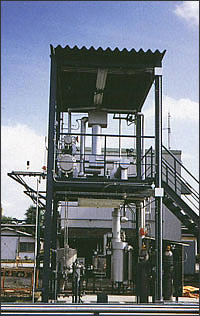
Membrane separation type solvent dehydration system

Great attention is recently being paid to global environmental issues, and it is now conceivable that companies will need to treat used solvents themselves. In consideration of this kind of social issue, we have developed a “membrane separation type solvent dehydration system,” which uses a polyimide membrane with superior dehydration properties developed by Ube Industries, Ltd. in combination with our own distillation and concentration technology that has resulted in solvents being more easily recovered.

THREE:[See larger version]On the 15th of March he took a more decided position of hostility to the Cabinet, by moving for an inquiry into the state of the navy. The Earl St. Vincent was now First Lord of the Admiralty, and he proved quite incompetent. Many gunboats had been broken up from motives of economy, and naval stores sold, for the most part, to the French. Pitt declared that only twenty-three gunboats had been built since January, 1803, and that the whole management of the navy was inert.
  • 1Under the distillation system, even in case of azeotropic solvent compositions, this system which remove water vapor by the polyimide membrane will easily dehydrate.
  • 2In comparison with the distillation system, it significantly saves on use of steam.
  • 3Dehydration can be performed through merely supplying evaporated vapor to the membrane module and maintaining the differential pressure between the permeable side and the impermeable side.
  • 4Solvent purity of 99.9% or more can be achieved by carrying out dehydration with a polyimide membrane only.
  • 5The polyimide membrane has superior heat and solvent resistance. Therefore, the vapor permeation system reduces contamination of the membrane and thus extends its life.
THREE:[315][See larger version]

The aromatic polyimide membrane is highly permeable to water vapor but less permeable to vapors of organic compounds such as alcohol etc.

THREE:III., c. 83) { 2 single parishes 2The spring of 1720 was a period of remarkable national prosperity. But "the grand money schemes projected of late," which appeared to the Jacobite Atterbury and others calculated to cement the royal peace and strengthen the foundation[46] of the Government and nation, were destined to produce a very different effect. For the South Sea Bubble was about to burst. In 1711, Harley, being at his wits' end to maintain the public credit, established a fund to provide for the National Debt, which amounted to ten millions of pounds. To defray the interest he made permanent the duties on wine, vinegar, and tobacco, etc. To induce the purchase of the Government stock, he gave to the shareholders the exclusive privilege of trading to the Spanish settlements in South America, and procured them an Act of Parliament and a royal charter, under the name of the South Sea Company. The idea, hollow and groundless as it was, seized on the imagination of the most staid and experienced traders. All the dreams of boundless gold which haunted the heads of the followers of Drake and Raleigh were revived. The mania spread through the nation, and was industriously encouraged by the partisans of Harley. But this stupendous dream of wealth was based on the promises of Ministers, who at the Peace of Utrecht were to secure from the Government of Spain this right to trade to its colonies. The right was never granted by that haughty and jealous Power, further than for the settlement of some few factories, and the sending of one small ship annually of less than five hundred tons. This, and the Assiento, or privilege of supplying those colonies with African slaves, were the sole advantages obtained, and these were soon disturbed by the war with Spain, which broke out under Alberoni. The South Sea Company, however, from its general resources, remained a flourishing corporation, and was deemed the rival of the Bank of England.
  • 1 Recovery of the detergent solvent Recovery of the cleaning solvent such as electronic parts industry, precision instrument industry.
  • 2Solvent recovery and the refinement Solvent recovery and the refinement such as chemical industry, an industry of medical supplies, food industry, the fermentation industry.
THREE:Wilberforce, on the 27th of January, had obtained a committee of inquiry into the slave trade. He, Clarkson, and the anti-slavery committees, both in London and the provinces, were labouring with indefatigable industry in collecting and diffusing information on this subject. The Committee of the Commons found strong opposition even in the House, and, on the 23rd of April, Lord Penrhyn moved that no further evidence should be heard by the Committee; but this was overruled, and the hearing of evidence continued through the Session, though no further debate took place on the question.

Acetone, ethanol, methyl ethyl ketone, butanol, isopropyl alcohol, ethyl acetate, methyl isobutyl ketone, others (including hexane and toluene).